

Agro-terrorism: Not So Far From Reality!
Agro-terrorism has received little or no attention in India [or for that matter in South Asia] because terrorists have yet to employ agricultural assaults as a method of operation in this region. The threat scenario would involve a deliberate introduction of a disease agent, either against livestock or into the food chain, for purposes of undermining stability and/or generating fear among masses. Even terrorist group can achieve their objective by using radiological dispersal devices against food or water supply.

Nuclear Energy is Back: Can it Stop Climate Change?
The world’s biggest economies are set to prepare for massive investments in nuclear energy. The most elusive energy, which was discarded in the 1992 Earth Summit as ‘not safe and sound’ energy, has been touted as the best alternative for the energy-crunch world in the recently concluded Group of Eight (G- 8) Summit meeting at St. Petersburg, Russia. After shock waves of the Three Miles and Chernobyl accidents, the nuclear energy is back to reduce the greenhouse gas emissions, the root cause of climate change.

Nepal: Reflections on the Failure of Governance
It has been proved several times in the history of nation states that credible mechanism of governance takes years to build but may collapse in a single stroke. Nepal, today, is experiencing the same. Over the years Nepal has been forced to witness the systemic collapse of its political institutions. Democracy in Nepal is still far from realization, as the landlocked Himalayan Kingdom remains entangled in a two-way fight between the autocratic monarchy and Maoists.
Violent Forests: Indian Woodland under Naxal Threat
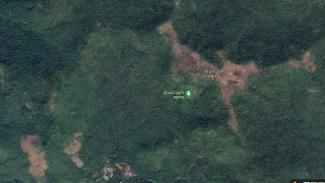
The forests of India are now under a novel threat posed by extremist outfits. Starting from the Hizbul Mujahideen to Naxals (the Left-wing extremists), all find the forest their safest hideouts to continue their anti-social and anti-national activities, including planning and deployment. According to the Union Ministry of Environment and Forest (MoEF), half a million crimes are reported from India's forest areas every year, and about 30% of it is related to militancy in these areas.
Bush Sojourn and Indo-US Nuclear Deal
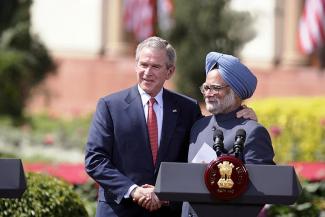
Wrapping up his three-day India sojourn, US President George W. Bush reiterated that the relationship between India and the United States was 'closer than ever before' and that India was a natural ally for the US. Ally or not, after months of intense deliberations and hard bargaining, India and the US have inked a landmark civilian nuclear cooperation agreement in New Delhi in early March, allowing India to access U.S. nuclear fuel and technology to meet its growing energy requirements.

Bangladesh: The Locus of Islamic Terrorism
After months of investigations, authorities in Bangladesh slapped a 40-year jail sentence to three militants of the outlawed Islamic outfit Jamaatul Mujahideen Bangladesh (JMB) blamed for a series of bombings in the country in 2005. Two convicts— Mohammad Awal and Ataur Sunny— have confessed their involvement in the 17 August countrywide bombings that killed three people and left over 150 injured. They also confessed that two British nationals financed the August serial bombings.
Ship Breaking in India: Environmental and Occupational Hazard
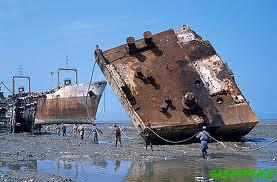
India is becoming a graveyard for the dying ships. And so it is for the workers of the shipyards too. Shipbreaking is also environmentalists’ nightmare. Toxic materials, most of which are highly hazardous, are dumped in the ship-breaking yards of India. The most tragic part of the story is the fate of the workers who are facing fatal occupational hazards. Not to forget, India is one of the six surviving ship-breaking nations in the world, along with China, Bangladesh, Turkey, Pakistan and Myanmar.

Are LTTE Sea Tigers Getting Impatient?
The fragile truce, effective from February 23, 2002, between the Sri Lankan government and the LTTE was finally shattered after the Tamil Tiger rebels blew up a Sri Lankan navy Dvora class gunboat outside Trincomalee harbour on January 5, 2006. The suicide attack was the work of an LTTE-owned explosives-packed fishing boat that rammed into the naval vessel, resulting in 13 sailors missing and presumed dead. Earlier, three sailors aboard a smaller naval patrol craft were killed more than two weeks ago in a sea battle with rebels off the northwestern town of Mannar.

Chhattisgarh: Red War Continues
Chhattisgarh played second fiddle to neighbouring Andhra Pradesh in the lists of worst affected Maoist or Naxalite states in the year 2005. The state experienced an escalation of violence since the beginning of the euphemistically called Salva Zudoom (peace initiative) in June last year. Data on Maoist violence compiled by the State police revealed that in 2005, 130 villagers and 39 police personnel lost their lives, and 70 more were injured in Maoist attacks.