
Commentaries
SSPC Issue Brief Series: 'India and the European Union Building Strategic Resilience"
October 24, 2026
This India-EU special series features contributions from scholars in the Department of Science, Technology and Policy Studies, School of Language and Literature/Humanities, Nalanda University, Bihar, India.
Background
India and the European Union face a shared challenge: economic integration and technological cooperation can deepen interdependence while leaving essential industries vulnerable to concentrated suppliers, export restrictions, and infrastructure disruptions. This India-EU special series, featuring contributions from scholars in the Department of Science, Technology and Policy Studies, School of Language and Literature/Humanities, Nalanda University, Bihar, India, examines how cooperation can reduce these vulnerabilities while accommodating differences in foreign policy, regulation, and security priorities. Its guiding concept is resilient interdependence: preserving the benefits of openness while developing alternative sources, deployable capabilities, and the capacity to withstand disruptions.
The 16th India–EU Summit, held on January 27, 2026, strengthened the institutional basis for this effort. Leaders endorsed the Towards 2030 Joint Comprehensive Strategic Agenda, signed a Security and Defense Partnership, and announced the conclusion of free-trade negotiations.[i] These developments link commerce, technology, and security; however, political agreement alone does not deliver operational capacity. The strategic agenda creates no legally binding obligations or financial commitments, and the conclusion of FTA negotiations must be distinguished from the agreement’s entry into force. [ii] The central question is how existing institutions can translate shared priorities into funded projects and capabilities.
1-Swapnil Kumari and Abhijit Poddar, “India and the European Union Beyond Strategic Partnership to Resilient Interdependence”, SSPC Issue Brief, October 26, 2026
The first paper establishes the analytical framework. It explains why cooperation does not necessarily imply geopolitical alignment, including adopting a common policy toward Russia or China. It identifies five priorities: conducting vulnerability assessments through the Trade and Technology Council (TTC); aligning research with capability gaps; establishing a proposed science and technology policy observatory; evaluating outcomes based on capability rather than activity; and promoting institutional interoperability. The observatory is a recommendation, not an established institution.
2-Swapnil Kumari, Rajeev Ranjan and Abhijit Poddar, “Minerals and the Economic Security Test for India and the European Union,” SSPC Issue Brief, October 30, 2026
The second paper applies this framework to critical minerals. It links India’s National Critical Mineral Mission and the EU’s Critical Raw Materials Act to bilateral opportunities in processing, research, recycling, and overseas sourcing. It distinguishes access to mineral deposits from the capacity to produce reliable industrial inputs. The €15.2 million battery-recycling call announced in May 2026 represents a concrete initiative; its contribution should ultimately be assessed based on demonstrated recovery technologies and industrial deployment. [iii] Financing, project lead times, and benefits for resource-producing countries remain essential considerations.
The Wider Program
A third paper will examine maritime and infrastructure security, including sea lanes, ports, and undersea cables. It will consider how India and its European partners can protect the physical connections on which trade, energy, and digital services depend. A possible fourth paper will address cyber and information resilience, including generative AI and disinformation, while distinguishing military information operations from civilian measures and safeguards for legitimate public debate. These papers will extend the same vulnerability-based approach rather than treating resilience as an unlimited security agenda.
Across the series, science and technology policy links research cooperation to industrial and security outcomes. Each paper will distinguish existing commitments, initiatives in development, and new recommendations; identify the responsible institutions and implementation constraints; and assess progress in relation to the problem addressed. Relevant measures include the availability of alternative qualified suppliers, expanded processing capacity, technologies advancing to deployment, interoperable systems, and improved continuity during disruptions. The series will evaluate the partnership based on the vulnerabilities it reduces and the capabilities it sustains, while recognizing constraints arising from commercial viability and differing strategic choices.
Notes
[i] India-EU Joint Statement on the State Visit of H.E. Mr. Antonio Costa, President of the European Council, and H.E. Ms. Ursula von der Leyen, President of the European Commission, to India, and the 16th India-EU Summit (25–27 January 2026), https://www.consilium.europa.eu/media/2c3jbm5f/eu-india-joint_statement…
[ii] India–EU joint statement and Towards 2030 strategic agenda, January 27, 2026. https://www.consilium.europa.eu/media/2c3jbm5f/eu-india-joint_statement_20260127.pdf
[iii] EEAS, EU–India joint initiative on EV battery recycling, May 06, 2026. Source, https://www.eeas.europa.eu/delegations/india/eu-and-india-launch-major-%E2%82%AC152-million%E2%82%B9169-crore-joint-initiative-revolutionize-ev-battery-recycling_en
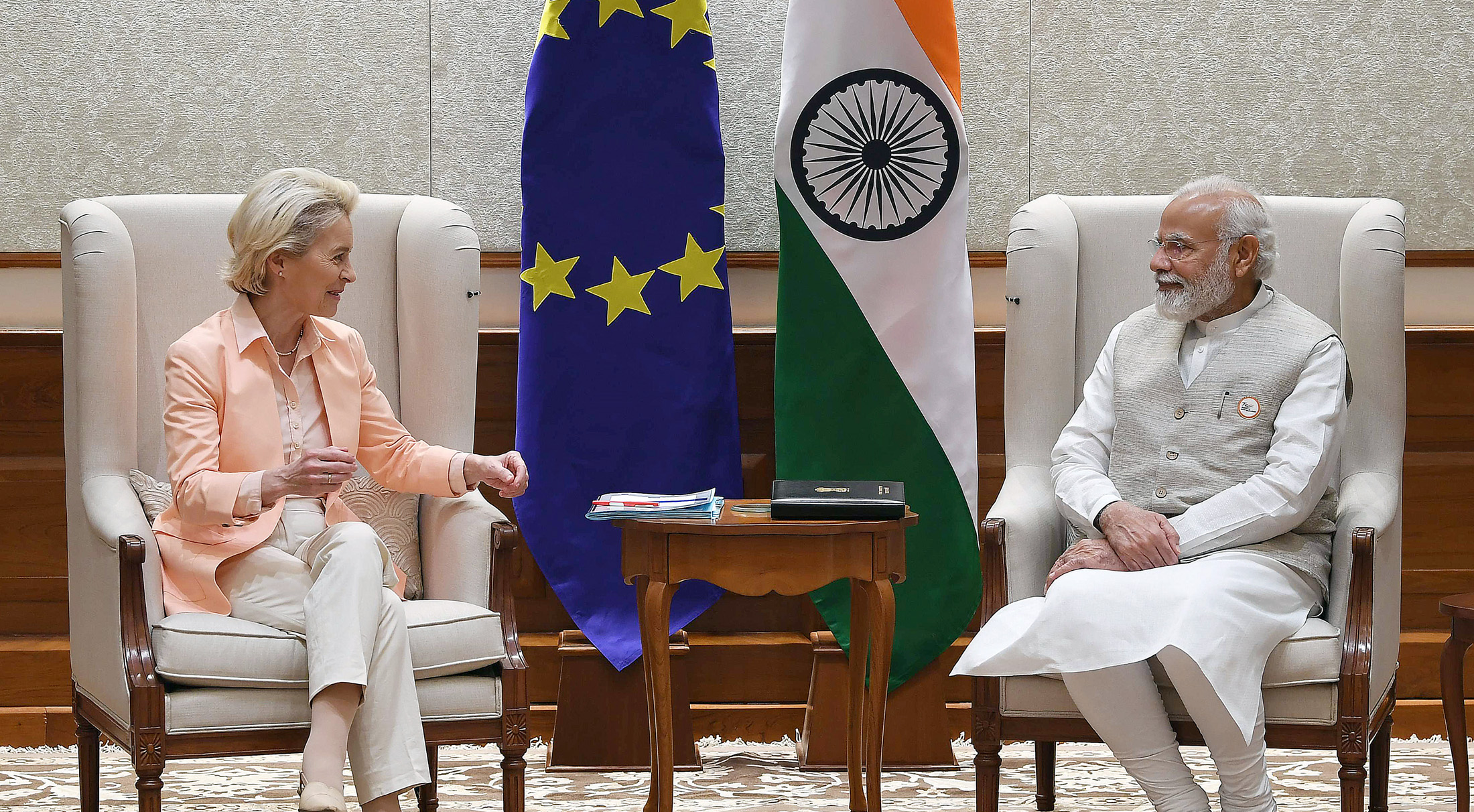
Image: Press Information Bureau (PIB), India, 2022/2026