
book-review
Handbook of Terrorist and Insurgent Groups: A Global Survey of Threats, Tactics, and Characteristics

June 4, 2026
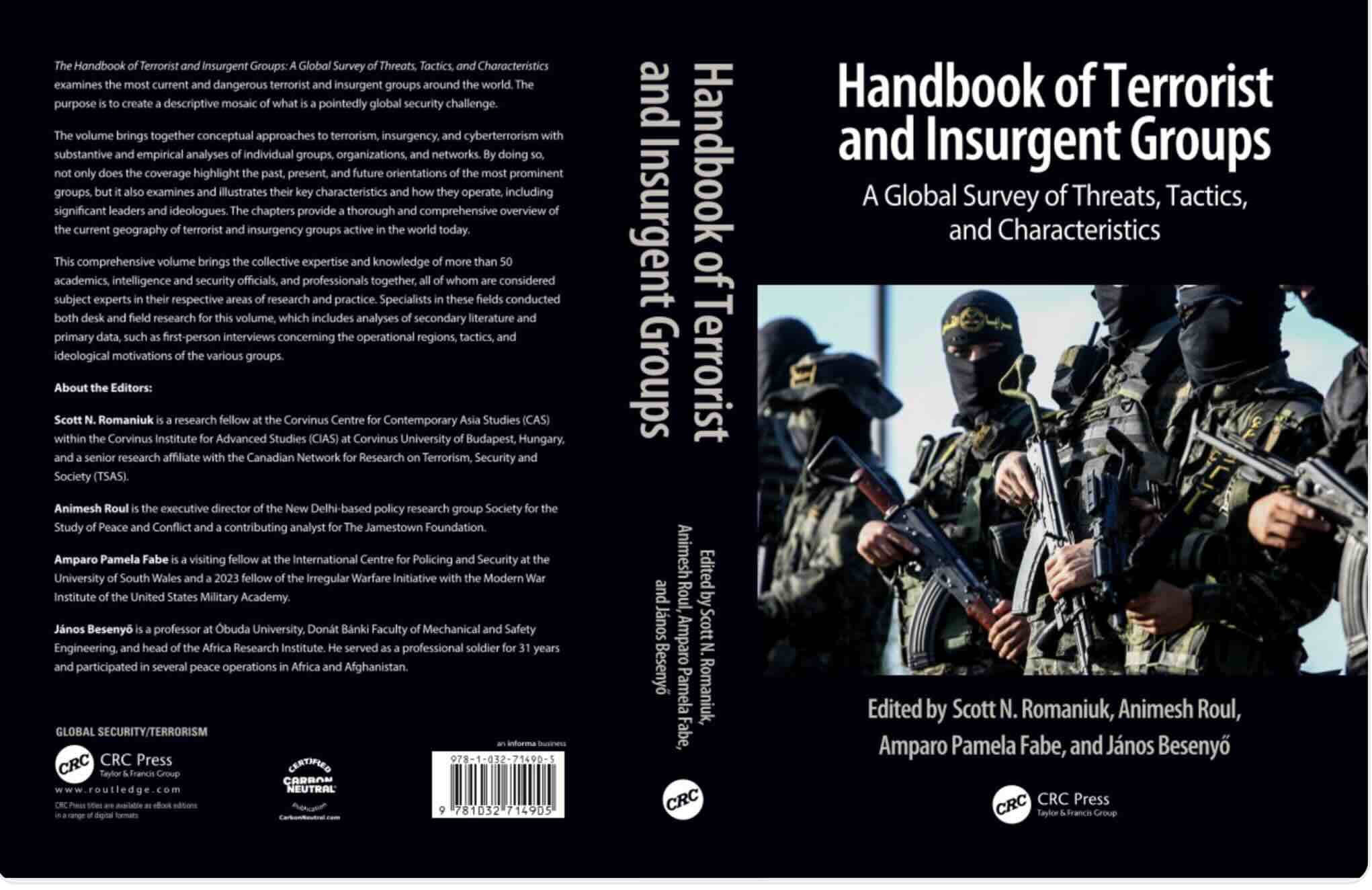
The Handbook of Terrorist and Insurgent Groups: A Global Survey of Threats, Tactics, and Characteristics (Edited By Scott N. Romaniuk, Animesh Roul, Amparo Pamela Fabe, János Besenyő, CRC Press, 2024) is an ambitious and wide-ranging edited volume on contemporary terrorism and insurgency. It examines how violent non-state actors have evolved since the September 11, 2001, attacks and how their ideologies, organizational structures, financing methods, operational tactics, and territorial ambitions have changed across regions. The editors frame the volume around five major themes: typologies of terrorism, the use of digital platforms and online spaces, the global prominence of jihadist organizations, the persistence of communist and left-wing insurgencies, and the changing mechanisms of terrorism financing. The book's main contribution lies in its breadth. It does not treat terrorism as a single, uniform phenomenon. Instead, it brings together conceptual debates and regional case studies to show how terrorist and insurgent groups differ in purpose, structure, ideology, recruitment, governance practices, and use of violence. The volume is therefore useful not only as a reference work on specific organizations, but also as a comparative guide to the broader terrorism and insurgency landscape.
Conceptual and Theoretical Framework
The first part of the book establishes the conceptual foundation. The chapters on insurgency, counterinsurgency, typologies of insurgency, and terrorism clarify the differences between terrorism and insurgency while also showing where the two overlap. Olivier Lewis and Scott N. Romaniuk's discussion of insurgency is particularly useful because it places armed resistance within the wider problem of contested sovereignty. Uddipan Mukherjee's chapter on counterinsurgency traces the historical roots of counterinsurgency practice and argues for a balanced approach that combines older and newer methods. Donald Stoker's chapter on typology further strengthens the conceptual discussion by focusing on the political aims of insurgents and counterinsurgency forces.
Several chapters examine terrorism as a communicative and political act rather than merely a form of violence. Scott N. Romaniuk and Olivier Lewis underline the coercive and symbolic dimensions of terrorism, while Salvin Paul, Sanchita Bhattacharya, and Romaniuk explore the epistemological difficulties in defining and understanding terrorism. These chapters are valuable because they caution against narrow or poorly defined approaches that can lead to analytical errors and policy overreaction. The volume also addresses the relationship between terrorism, religion, extremism, and fundamentalism. The chapters by Wangchu Lama and Salvin Paul, and by Salvin Paul, Alok Kumar, and Scott N. Romaniuk, examine how religious ideas can be politicized and converted into violent mobilization. The book does not reduce terrorism to religion alone; rather, it places religion within wider ideological, political, and strategic contexts. Other chapters broaden the discussion by examining limited war, urban terrorism, hybrid threats, the crime-terror nexus, state-sponsored terrorism, market-state terrorism, homegrown terrorism, lone-wolf attacks, and the transition of armed groups into party politics. These contributions show the changing boundaries of terrorism studies. They also demonstrate how terrorist and insurgent groups increasingly operate across political, criminal, social, and digital spaces. The chapters on Salafi-jihadi governance, terrorist franchising, high-value targeting, disengagement from armed conflict, and the role of women in terrorism add further depth to this section.
Cyber-Terrorism and Online Radicalization
The second part focuses on cyber-terrorism and digital mobilization. Tobias Burgers and Scott N. Romaniuk examine the historical use and misuse of the concept of cyber-terrorism and discuss the risks it poses to critical infrastructure and public psychology. Wendell C. Wallace and Romaniuk analyze how terrorist organizations use social media and digital platforms for propaganda, recruitment, networking, and operational facilitation. Their argument that social media can function as "oxygen for terrorism" captures the centrality of online spaces in contemporary extremist ecosystems.
Richard McNeil-Willson and Romaniuk add an important counterterrorism perspective by examining the limitations and ethical dilemmas of cyber-counterterrorism. The chapter on security awareness in the healthcare sector by János Besenyő and Attila Máté Kovács extends the discussion beyond traditional security institutions. It shows how digitalization has created new vulnerabilities in critical civilian sectors, especially through ransomware and phishing attacks. This section is one of the more contemporary parts of the volume because it connects terrorism studies with cyber risk, critical infrastructure protection, and online radicalization.
Regional Case Studies
The regional sections form the largest part of the book. Together, they provide a detailed survey of terrorist and insurgent groups across Africa, the Americas, Europe, the Middle East, Central Asia, South Asia, Southeast Asia, and the Indo-Pacific. The Africa section covers al-Shabaab, Boko Haram, Ansar al-Dine, al-Qaeda in the Islamic Maghreb, the Movement for the Liberation of Azawad, and the Lord's Resistance Army. The chapters show how fragile governance, local grievances, ideological mobilization, and regional instability have sustained violent movements across Somalia, Nigeria, Mali, the Sahel, and Central Africa. The discussion of al-Shabaab's Amniyat is particularly important because it highlights the intelligence, administrative, and coercive functions that enable terrorist groups to survive beyond battlefield operations. The section on the Americas examines the Revolutionary Armed Forces of Colombia, Sendero Luminoso, the Zapatista Army of National Liberation, the National Liberation Army, and the Camarena case. These chapters bring attention to Marxist, Leninist, Maoist, indigenous, and narco-political dimensions of insurgency and terrorism.
The Europe section considers the Irish Republican Army, the Fighting People's Revolutionary Powers in Greece, Chechen terrorism, and Euskadi Ta Askatasuna. These chapters show that European terrorism has been shaped by separatism, anti-establishment militancy, nationalism, and post-conflict radicalization. The chapter on ETA usefully demonstrates how sustained counterterrorism cooperation, especially between Spain and France, contributed to the weakening of a long-running separatist terrorist movement. The section on the Near and Middle East examines the Kurdistan Workers' Party, the Syrian Muslim Brotherhood, Hezbollah, Hezbollah in Turkey, Hamas, the Islamic State, Hay'at Tahrir al-Sham and Jabhat al-Nusra, al-Qaeda in the Arabian Peninsula, Ansar Allah, the Izz ad-Din al-Qassam Brigades, and Jaish al-Mahdi. This section captures the diversity of violence in the region, including sectarian militancy, jihadist insurgency, religious nationalism, proxy warfare, and militia politics. The chapters (e.g., on ISIS, AQAP, HTS, Hamas, and Hezbollah) are especially significant because they show how armed groups combine ideology, governance, finance, media strategy, and military capability.
The Central Asia section covers al-Qaeda Central in Afghanistan and Pakistan, al-Qaeda in the Indian Subcontinent, the Taliban, the Haqqani Network, the Islamic Movement of Uzbekistan, Islamic State-Khorasan Province, and the Balochistan insurgency. The chapters highlight Afghanistan and Pakistan as central theatres in the evolution of transnational jihadism and regional insurgency. The discussion of ISKP is useful for understanding the Islamic State's regional adaptation, its recruitment of foreign fighters, and its operational impact in Afghanistan and Pakistan. The South Asia section is among the most relevant parts of the volume for readers interested in Indian and regional security. It covers Hizbul Mujahideen, the Indian Mujahideen, Maoist insurgencies in India, the Maoists of Nepal, Lashkar-e-Taiba, Jaish-e-Mohammad, Tehrik-i-Taliban Pakistan, the Liberation Tigers of Tamil Eelam, Jamaat-ul-Mujahideen Bangladesh, and the United Liberation Front of Assam. These chapters reflect the diversity of South Asian militancy: Islamist terrorism, ethno-nationalist insurgency, Maoist mobilization, separatist violence, and cross-border proxy warfare.
The final regional section examines Southeast Asia and the Indo-Pacific. It includes chapters on Tibetan resistance, the Abu Sayyaf Group, the Moro Islamic Liberation Front, the Communist Party of the Philippines, ethnic armed groups in Myanmar, the Arakan Rohingya Salvation Army, Islamic insurgency in Southern Thailand, Jema'ah Islamiyah in Indonesia, and the Maoist insurgency in the Philippines. This section shows how local grievances, ethnic identities, religious mobilization, separatist claims, and transnational jihadist influences have interacted across the region. The chapters on ARSA, Jema'ah Islamiyah, Abu Sayyaf, Southern Thailand, and Myanmar's ethnic armed organizations are definitely valuable for understanding the blurred line between insurgency, terrorism, separatism, and communal violence.
Assessment
The strongest feature of the Handbook is its range. Few volumes bring together so many terrorist and insurgent organizations within a single analytical framework. The book is especially useful for researchers, students, security analysts, and policy practitioners who need a broad reference on group origins, ideologies, leadership patterns, organizational structures, tactics, financing, recruitment, and future trajectories. The volume also succeeds in moving beyond a jihadism-only understanding of terrorism. While jihadist organizations remain central to the contemporary threat landscape, the book also gives space to communist, Maoist, separatist, nationalist, ethnic, and criminal-insurgent movements. This makes the volume more balanced and analytically useful. It also reminds readers that terrorism and insurgency are not confined to one ideology, region, or religious tradition. At the same time, the book's breadth creates some limitations. Since it covers a very large number of groups, the depth and analytical consistency of chapters may vary. Some chapters are more conceptual and interpretive, while others are more descriptive. A stronger concluding section that draws comparative lessons across regions would have helped readers identify broader patterns more clearly. The rapidly changing nature of terrorism and insurgency also means that some assessments will require periodic updating, especially in relation to jihadist franchises, online radicalization, state responses, and conflict zones such as Afghanistan, the Sahel, Myanmar, and the Middle East.
Conclusion
Overall, the Handbook of Terrorist and Insurgent Groups is a substantial and useful contribution to the study of terrorism and insurgency. It combines conceptual inquiry with global case studies and provides a wide map of contemporary violent non-state actors. Its value lies in showing the diversity of modern terrorism: from jihadist movements and proxy groups to Maoist insurgencies, separatist organizations, cyber-enabled networks, and armed groups seeking political transformation. The book will serve as a valuable reference for scholars, practitioners, and readers interested in the evolution, tactics, and future directions of terrorist and insurgent movements worldwide.
Romaniuk, S. N., Roul, A., Fabe, A. P., & Besenyő, J. (2024). Handbook of Terrorist and Insurgent Groups: A Global Survey of Threats, Tactics, and Characteristics. CRC Press/Routledge. https://doi.org/10.4324/9780429426063-1
Reviewed by: Keshav Chandra Tripathi, Doctoral Research Scholar, Centre for Inner Asian Studies, school of international studies, Jawaharlal Nehru University, New Delhi.